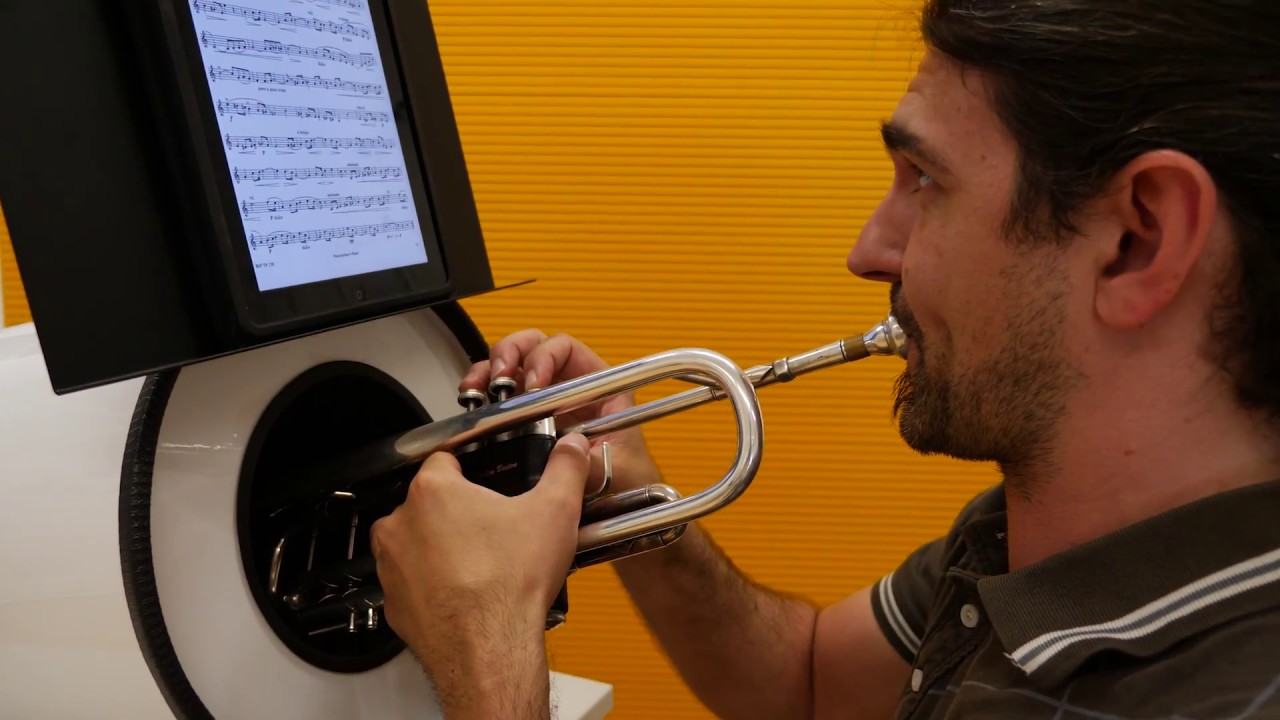
you’re reminding me of a sound trap used in ventilation ducts.
same principle as a muffler, you make a box with an opening larger in diameter than your didgeridoo bell, the box needs to be bigger to trap the sounds and have some rockwool with mesh in it and at the end of the box make another similar outlet and you’re done.
Yes @Ooki_Tan,
I’d already noticed this type of product, the comments seem very positive. Is there a trumpet or sax player who could tell us more?
The question is how it could be adapted to a didge, maybe with some kind of wooden interface?
Hey everyone, I got the chance to test a Yamaha electronic mute (which a work colleague who plays French horn kindly lent me ) and… It doesn’t work ^^ basically the circular breathing gets completely cut off because the air doesn’t expel enough (whereas brass instruments actually exhale very little air when you think about it), the mute obstructs the air column too much so the solution is leaning more towards acoustic boxes to let the air fully escape.
I also asked my acoustics expert if he knows any solutions, and for him it would have to be an electronic box with microphones. Today that’s the only way to preserve sound quality without being loud ^^
Hi,
I stumbled upon this video by chance and it reminded me of that old thread about playing didge in an apartment.
Based on the principle of the box shown above, but closed at the front.
I’m worried it might cut a lot of the highs and the sound perception, like when you play outside (or even worse), which is why it might be worth adding a mic for direct feedback.
The model shown is sold at Thoman but at a pretty steep price. I think the DIY-savvy folks can do it for much cheaper with cork sheets and foam board – you can find them at the hardware store pretty cheap.
The listing says a reduction of 25-30 db, which for a didge brings the volume from 70-80 db down to 50 db or so, that’s about the volume of a TV more or less. That should be totally acceptable for the neighbors (unless you can hear their TV when it’s on )
If anyone has feedback on this, don’t hesitate to share it with us.
… well yeah, thanks @Elisabeth_Blanc, where’s the video, scatterbrained me
I’m adding it … here it is
That looks like a pretty decent product, would be nice to try it out with a didgeridoo but I agree with you @Christophe_E a good handyman could do it cheaper
I think many of us have to share our sound environment with other living beings (partner, neighbour, kids, parents, cat, dog, etc.) who can sometimes be bothered by our instrument’s volume (hum ).
I have a really nice and understanding neighbour, but I still feel bad about subjecting him to an hour of didge in the middle of the night, and I’ve been racking my brain for a while now looking for solutions so I can practise anytime.
Basically, for me it’s either:
choose to practise techniques that are lighter in volume (aircode, or playing the drone as low as possible) which is cool because it forces you to work on techniques other than usual, but which can sometimes be a bit frustrating.
Or intervene on sound propagation, but I have to say my results aren’t great…
I’ve put together a kind of box made of acoustic foam with an open face where I place the bell of the didge. It’s pretty good for recording, but the sound coming out of it is quite horrible.
Actually I’m running into the same problem in all my attempts: The harmonics get swallowed up right away, but the bass stays very present… whereas it’s precisely the low frequencies I’d want to reduce.
So, what are your tricks? Can you manage to lower the volume while keeping a clear sound?
Yes, it’s good to see that there’s really no perfect solution…
because as the Shadoks say: if every problem has a solution, if there’s no solution, then there’s no problem.
This solution with a foam box and a mic inside is what I’ve found to be the most effective too, but I find it so sad to hear my didge, so beautiful in its simplicity, filtered through all these electronic connections


 .
.
 ) and… It doesn’t work ^^ basically the circular breathing gets completely cut off because the air doesn’t expel enough (whereas brass instruments actually exhale very little air when you think about it), the mute obstructs the air column too much so the solution is leaning more towards acoustic boxes to let the air fully escape.
 )
)