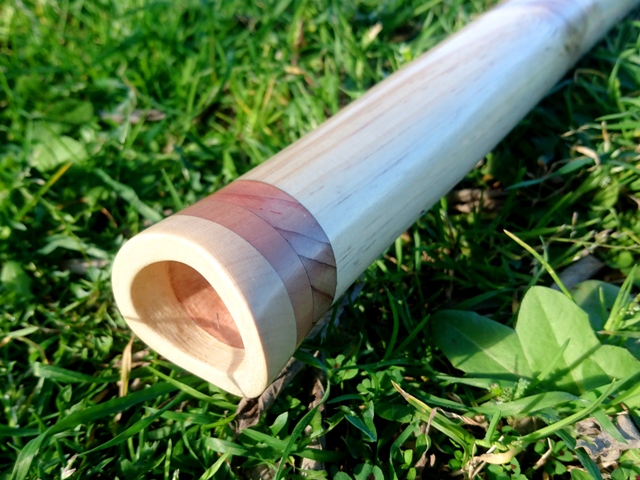
Hey @olivier.pontac, here’s an example of a mouthpiece that Dubravko Lapaine uses
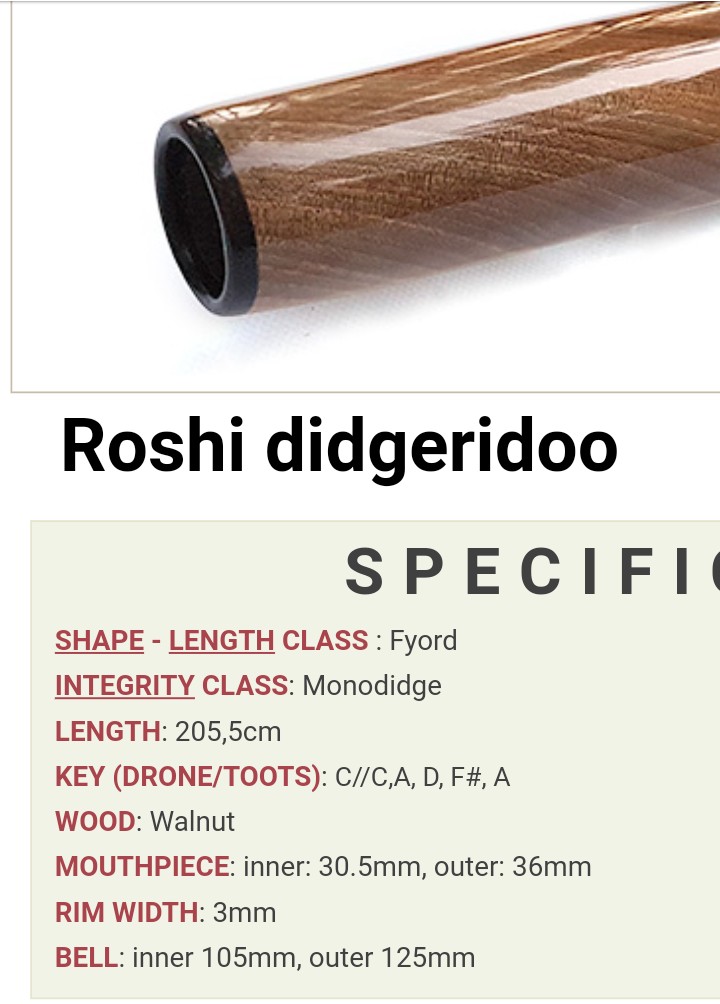
His site is full of treasures!
I found more information about different mouthpieces on this site https://www.stargazercs.com/didgit/Articles/didg_mouthpiece.html
Hey @olivier.pontac, here’s an example of a mouthpiece that Dubravko Lapaine uses
I found more information about different mouthpieces on this site https://www.stargazercs.com/didgit/Articles/didg_mouthpiece.html
You’re right, there’s quite a bit of good stuff to pick up. And I learned a ton of things thanks to your share @Sébastien, thanks mate.
Just a quick clarification on mouthpieces because there are several things being said and we could easily get them all mixed up.
Dubravko plays with very prominent, very fine mouthpieces (like the photo above).
William developed mouthpieces by working on two parameters:
• the part where the lips rest is slightly curved to match the shape of the face.
• work on internal conicity imitating brass instrument mouthpieces (like you’re researching @Sébastien).
The first parameter will be hard to reconcile with Dubravko’s playing style because he plays almost exclusively in over-vibration, and in that case, the smaller, more knowledgeable and finer the mouthpiece, the better it will work. Basically, the opposite of William’s mouthpieces.
The second parameter can be interesting because it transforms the didgeridoo’s air column into a trumpet or an alphorn (in short, a didgeridoo taken to the extreme). Here the roundness of the sound gives way to pressure. This means that the fundamentals are reduced, the harmonics become metallic, cheek play won’t sound as much. In short, the sound spectrum is reduced.
On the other hand, all of this will amplify all techniques linked to pressure: over-vibrations and under-vibrations essentially.
As for Dubravko’s « open » playing (Air code I think), the more open the didgeridoo’s air column, the more it will generally resonate. This technique will certainly be somewhat reduced in a William mouthpiece.
Thanks for the clarification @Gauthier 
That really confirms the difference between these mouthpieces!
So here’s the final mouthpiece that came out of my latest experiment
This mouthpiece is very comfortable and allows you to increase the amplitude of your lips while staying airtight 
Pleasant and relaxing. Thank you so much.
Was that your yidaki? This question is actually just a pretext to ask you another one about your yidaki.
Yidakis are equipped with a beeswax mouthpiece. Do you take special care of this feature (regarding wear)? In practice, do you have to reshape it from time to time, which maybe isn’t straightforward for someone who isn’t handy with DIY (I’m not talking about you).
Thanks in advance for your answer.
@Patrick_GARBOUS nope, that was the didgeridoo I use to work on wobbles. It’s pretty versatile, you can make snappy WA’s pop or play quieter pieces, on this track I played gently, with not much pressure.
For the Mago, if you manage not to press too hard on the beeswax mouthpiece while playing, it can last like that for a really long time, with no particular maintenance. That’s the theory of good practice, but in reality I always end up pressing too hard on it and I crushed mine, so I added a sugarbag wax rope (bought from Didgeridoo-Passion) over the original mouthpiece by shaping it with my fingers until it felt right to play, my thing isn’t very pretty but it works.
I like playing without a mouthpiece addition, but the Mago’s is too wide to skip it, you have to have a beeswax one. Sugarbag wax is good because you can reshape it however you want, it stays a bit soft and workable without heating it, it has the downside of its advantage, meaning it’s a bit sticky and deforms with use. Other types of wax are harder, they should last longer without deforming. 
Hello,
I took the liberty of moving your question @Patrick_GARBOUS and your answer @Elisabeth_Blanc to this dedicated topic on mouthpieces so as not to clutter the post « didg au paradis »
To complement Elisabeth’s answer about « suggarbag » beeswax (which is black), I’d say that beeswax (yellow) is harder and doesn’t stick when you play. However, it does require regular maintenance:
Thanks @Christophe_E you did well.
You did the right thing moving my question to a more appropriate place. Thanks for the follow-up answer.
Thanks for your reply.
I’m digging up this very instructive topic a bit. 
Given all that, I’ve decided to redo the mouthpiece on my didgeridoo which really needed it.
I’m going with the beeswax option. In wood it would cost me more than my didgeridoo. 
After removing the wax, I measured the opening which was barely 30 mm. I took the opportunity to widen it to 35 mm. That way I could reduce it to 32 or even 30 mm if needed.
I saw a tutorial for redoing the mouthpiece with beeswax. They recommended melting some wax and dipping the mouthpiece to create a bonding layer for the wax rope that you then apply. Do you really think that’s necessary? 
Personally I don’t think it’s useful @Cédric33, when you apply it to the mouthpiece your beeswax roll will be a bit soft, you’ll be able to apply it without any problem, anyway after that you need to press it on the internal and external sides to make a small part go down inside and outside the mouthpiece to properly seal the beeswax and make sure there’s no sound loss.
I’ll take care of it this afternoon. Thanks
Hey Cédric,
Actually it all depends on whether you already have your wax bead or not.
If you already have a wax bead or even a ready-made ring like you can get in stores, it’s not really useful to dip your mouthpiece end. Like Elisabeth said, you’re going to have to heat and reshape your bead to apply it to the mouthpiece, so the grip will happen naturally.
If you haven’t made a bead, instead of making one, the technique of dipping the mouthpiece several times in a row into liquid beeswax is pretty effective. You wait a few seconds between each « dip », the beeswax sets, you do it again and you get to a good thickness of beeswax pretty quickly, then you can shape it however you want with your fingers.
Thanks for your feedback @Christophe_E
There was already some beeswax that I completely removed. I discovered there was a wooden mouthpiece insert embedded in my bamboo didg. I tried blowing without beeswax but it wasn’t very comfortable so I added some beeswax; even a bit on the inside. Great result. I just reworked the outer thickness because it was bothering me under my nose.
The opening is now 32mm whereas with the beeswax it was supposed to be 28mm initially.
Now time to get back to work to readapt to blowing face-on and a larger opening 
Hello Cédric
If you’re comfortable with 28mm I’d recommend sticking with that size, 4mm is quite a significant difference. If you have the option to reshape it with extra beeswax…
@Cédric I’ll admit I’m struggling with this right now. I’m thinking of reducing it to 30 mm. When I’m on the side no problem, but head-on, it’s not looking good I get the feeling air is leaking at the corner of my lips.
It’s not as easy as it looks to make a good beeswax mouthpiece. I redid the one on my Mago, and I’ve got the same air leakage problem. I’ve put it aside for now and I’ll get back to it later.
It needs to be really horizontal, mine isn’t quite level enough, and maybe you should try raising the sides a bit to see if that helps or if you still get air leaks, or maybe actually reduce it to 30 mins. Anyway, that’s just what I reckon… I’ve always made pretty dodgy beeswax mouthpieces, even though it looks so simple when you watch the YouTube tutorials.
Hi everyone,
I’m having some small mouthpiece issues and I need your valuable advice…
Just to recap, I live in New Caledonia where finding a didgeridoo, let alone a quality one, is like searching for the Holy Grail.
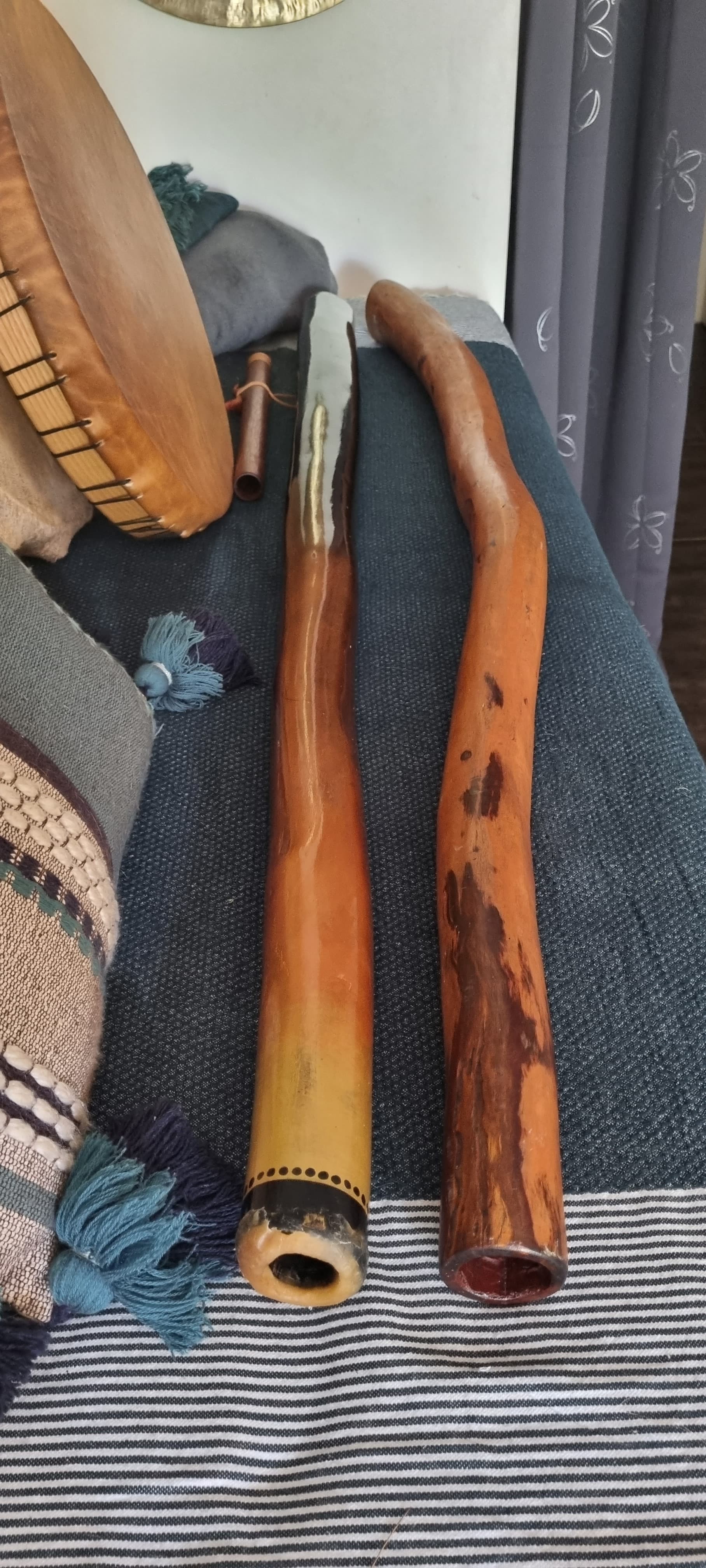
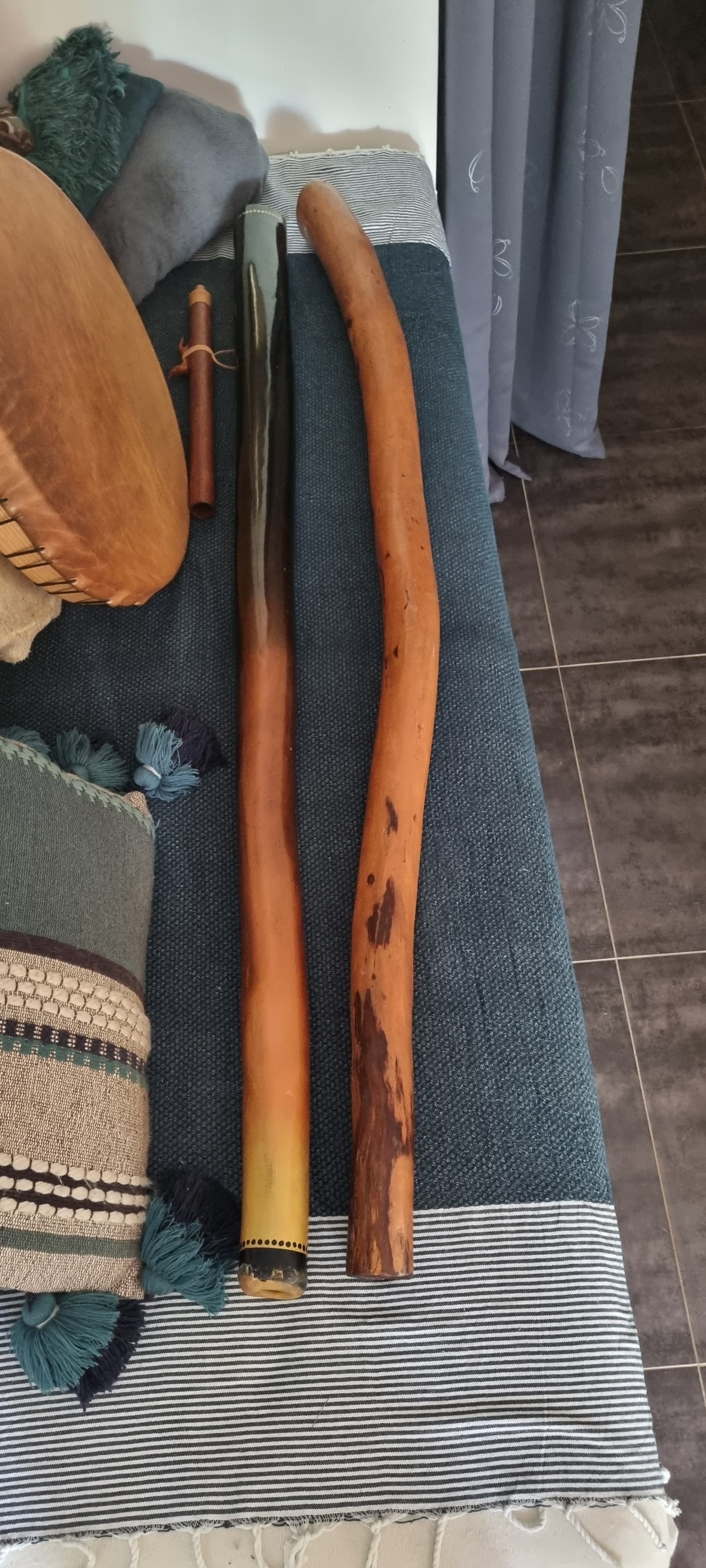
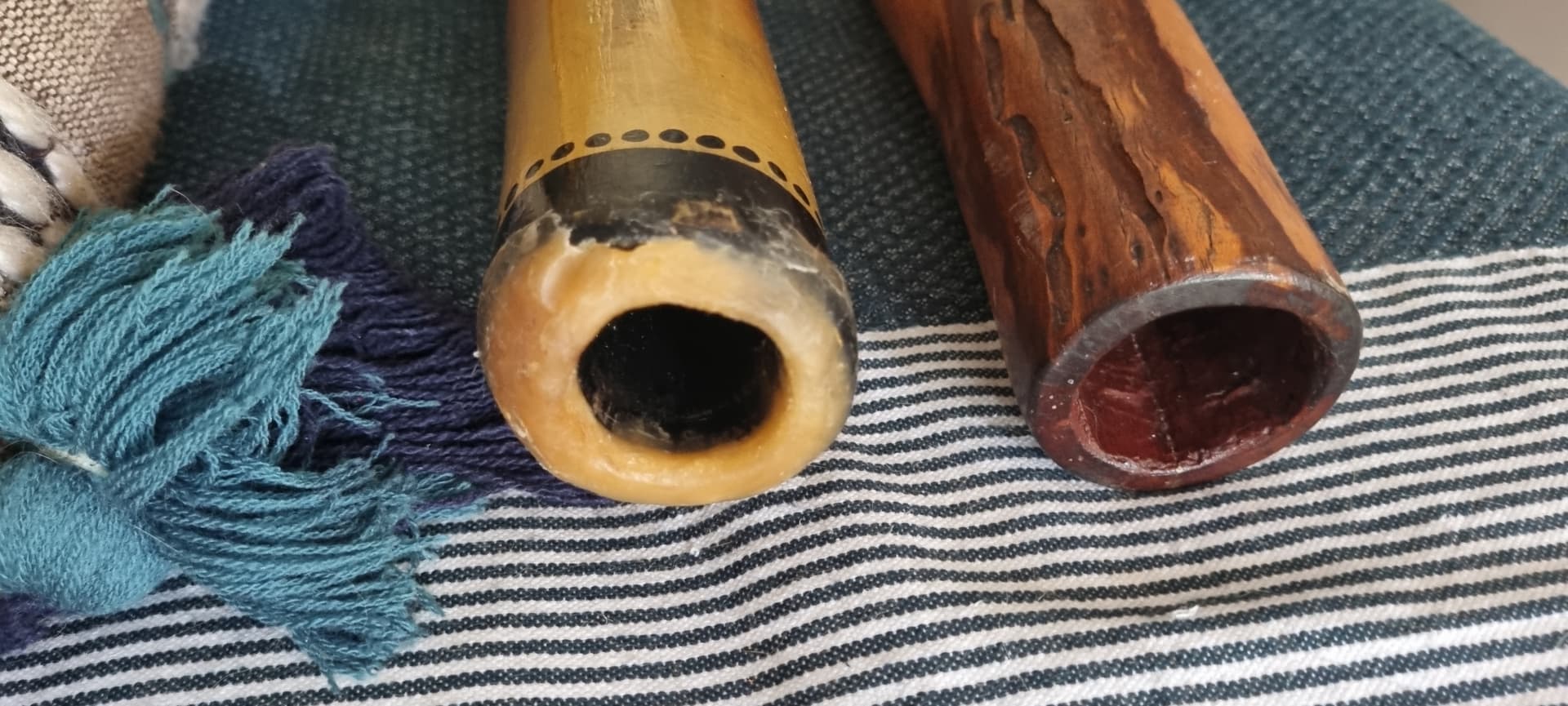
So I have a first didge (in E, I think) that I’ve been playing since the beginning and which has a beeswax mouthpiece. I’ve already tried to remake it because I get constant air leaks, the column is oval at the base (about 4 by 3.5 cm) and I have a small mouth. The only catch: I live in a hot country and I cart my instrument around all the time (and I’m not exactly a handyperson, maybe that’s a factor too?). Result: it doesn’t hold, it’s pretty frustrating.
4 days ago, a friend pops up all excited telling me he has a surprise for me: a friend of his left the territory and left behind a didgeridoo from Australia that, according to him, is a « real instrument » and not a tourist curio. It’s been sitting in a garage for more than 7 years but that didn’t put me off  : I’m planning to sand it down and give it a fresh coat of beeswax. I can’t play it yet, it doesn’t have a mouthpiece and the opening is too wide (4.2 cm) but tilting it to the side, the key sounds like a C.
I’m attaching photos of the instruments.
My questions:
)…That’s all from me.
Looking forward to hearing from you 
Eve