Ever experienced a trance state while playing didgeridoo?

Original title: « The Player’s Trance »

Hey everyone!

I’ve browsed quite a few forum topics, and I haven’t found one that talks about the trance state.
Note that I might have searched in the wrong way…

In the collective imagination, the didgeridoo is very much linked to trance: Its mystical history, its bass so deep that it can only anchor us to the earth, its performances that range from a simple drone to an endless and uninterrupted tangle of bounces and cries, always accompanied by its drone.

I’d like to know what your relationship with trance is, if you have one of course.
Have you ever entered a trance while playing? Do you know what triggers it for you? Have you ever tried to induce a trance state in yourself or someone else? What does your unconscious express in those moments that belong to it? What do you feel during and after the trance? Etc…

Why these questions, and why today?

I try to record at least one session per week, most of the time it’s stored and forgotten, but sometimes a cleaner piece stands out and I use it to work on mixing.
Yesterday I recorded my session, a typical session where I wanted to work on the sequence :go_joues: :to: :to: :gon_joues:, as usual, 20 minutes of warm-up, 30 minutes of exercise and I lose concentration and go into improvisation. I chain the tracks I have in stock letting myself go, until I come across a piece that set my mind on fire. I clearly felt that I’d come up with something cool, so I stopped and tried to mix the improv. It’s when I was editing with the video that I realized it, my unconscious had things to say.
0:36, you can see me trying to concentrate.
0:58, I’m concentrated.
1:13, I’m surprised by what’s happening, but I keep going, I let myself be guided, the unconscious begins to slowly creep in, through my right hand in this case.
1:45, I no longer have any say in it, my left hand holding the didgeridoo is discreetly replaced by my right hand, and there the message is clear, my left hand tells me: « Let me do it, I’ll show you how it’s done. »
1:58, impossible to miss my expression of surprise… There it goes, my shoulders shake, my fingers tap in the air, my arm makes waves, it goes up, down, to the right, to the left. It was its moment.
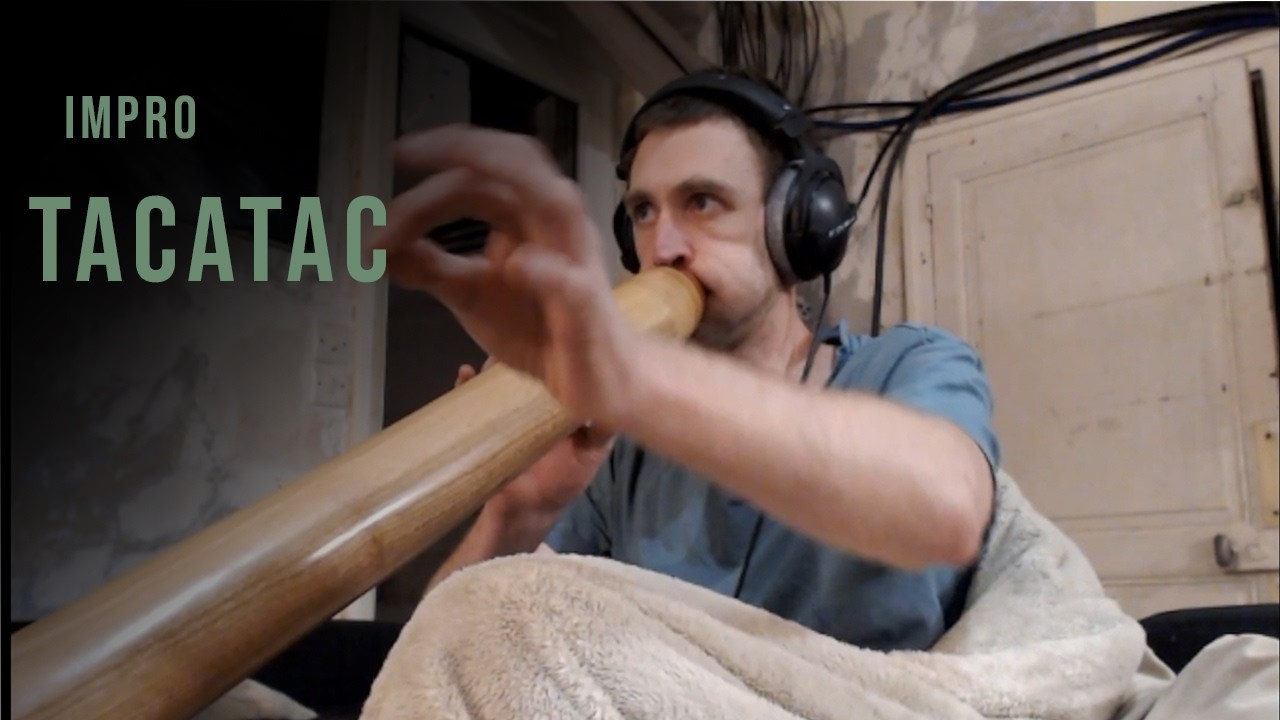
I’ve watched it a lot, really a lot and I barely understand 25% of my own playing…
More proof, if any were needed, of the incredible power of the unconscious. I know everything it knows, except I don’t know that.

Do you have any trance anecdotes to share?

2 Likes

Hi Charly
That’s an interesting topic.
As always, I’m just sharing my opinion here, it’s only mine.
As Coluche used to say, it’s my opinion and I’m sharing it :wink:.

My knowledge on the subject is relatively limited…
I think we need to be careful with the use of this word: Trance.
That’s just my opinion.

We’re in France and trance, looking at it from here, touches on things that are purely matters of neurochemistry in our brains on one hand and esotericism (an overused term)… on the other.
We don’t have a « culture » of shamanism, unlike the Mongols or Native Americans for example.
That’s just my opinion.
Out of respect and because I don’t know enough about it, I prefer to be careful with how I use this word.

Between what you really feel, what you think you feel, what your ego tells you to feel… what your ego tells you to express… We’re in France.
I come back to this because culturally, I think it’s important to take into account.
Anyway, I’m careful.

I looked into the subject of trance briefly, I admit it, through the work of Corine Sombrun thanks to her books and lectures.
She talks about Trance in a therapeutic sense (so for therapy).
She works (or has worked) with a whole bunch of brain specialists (neurologists, neurosurgeons, psychologists…) to understand and « prove », through tests, monitors, contemporary medical tools, the mechanisms of the brain and this link to what we call trance. Basically what’s happening in there.

What I got from it is that Trance, it seems, is not triggered by slow rhythms, but by fast ones, which might seem counterintuitive.

I’ll stop here, I’m not sure if that’ll help your thinking but I want to keep reading you and following you on this subject, if you have any elements to share.

Intellectually, it’s always interesting :wink:

Hey! Karl!

I live pretty far from notions of spirituality, esotericism or mysticism. I’m sensitive to the beauty of nature and I like to question myself about the world without really needing answers. So when I asked those questions about trance, I didn’t think for a second about the esoteric or spiritual slant of the term. I only saw the biological side of the phenomenon which, in that case, concerns at least humans, if not all living things. For me it’s a kind of temporary reorganization of brain activity.

But you’re right, we can sometimes make progress in ecosystems where ambiguity is possible. If you stay cautious, what term could you suggest that would avoid misunderstandings? Could we maybe talk about dissociation instead? That seems less loaded?

I’m not really sure how to put it, but I’m essentially interested in what we can experience around the didgeridoo. The topic of cultural appropriation, for example, was incredibly instructive—people shared what they see through the instrument: a primordial instrument, an ethnic treasure, a cultural symbol, a ritual instrument, a musical instrument, an escape tool and even a commodity. And although they didn’t all agree on what to make of it, they all agreed on the importance of respecting it.

It’s kind of the same idea here, I want to share, not what we see in it, but what it offers us. And more specifically about this dissociation phenomenon.

If we get past the word « trance », don’t you have a story to tell? Whether as a player or a listener? ^^

Hello!
I recommend this little podcast where they talk about it, with a hypnotherapist and a member of the TranseScience Research Institute (set up by Corinne Sombrun in fact):

What I take from it is that the trance state has several levels, and that as musicians we’re very often in that state, whether at a light level or higher.

3 Likes

Hello!

Thanks for the topic and the podcast – I found it really interesting and instructive. :slightly_smiling_face: It demystifies the word trance and I’m taking away that apparently within each of us exists this altered state of consciousness that we can access intentionally or unintentionally, and that it’s a resource, a potential.
And there’s this dissociation phenomenon you mentioned, Charly. It’s a short circuit between the cognitive, thinking side and emotions, the body on the other side – the feeling of being outside yourself and watching things unfold. And with what you explain about your experience when you play (in your first message), I wonder if dissociation opens a window to the unconscious… which could then express itself… kind of like in dreams…:thinking:
Anyway, it seems to me there’s a form of letting go and loss of control that free up the movements that emerge and creation.

I’m a beginner on the didge but it’s happened to me 2 or 3 times over short periods of time – I let go without realizing it and let myself go to play whatever comes. And my right arm and hand were drawing wide arabesques in the air while I was playing. I didn’t notice it right away. I was amazed at what I was capable of doing, and that feeling of fluidity, of lightness like something flowing – it was really pleasant.
Now I’m thinking it was maybe one of those moments a bit outside of time that the podcast talks about: a non-ordinary state of consciousness and so a trance that we can experience in our everyday life without knowing that’s what it is.

There’s my experience and my thoughts :slightly_smiling_face:

Thanks @Baptiste and @chrystelferraro for sharing.

I’m amazed by how much my own experience aligns with this podcast—it’s a gem! A real demystification and clear description of the symptoms of trance state, they even talk about this notion of dissociation. I feel genuine sincerity and open-mindedness in what they’re saying, I loved what they shared with us.

@chrystelferraro now that I can put a name to it, I can say I experienced trance as soon as I nailed my first circular breathing exercises, I was definitely a beginner^^ . I can even say, without much doubt, that it’s those state-change experiences that made me want to keep going.

By the way, do you remember what you were doing before those slides? The playing time since the start of the session, the exercises you’d done, the tempos you were playing?

I haven’t had time yet to test adding this experience with this new knowledge into my playing, but that’s coming soon, I’m super hyped!

Thanks again for your contributions.

2 Likes

@charlycoco_3 @Baptiste
I’m listening to the podcast right now, thanks so much Baptiste, by the way for sharing this.
It’s really helping me expand my knowledge and thinking on this subject, given my lack of familiarity :sweat_smile:

Charly to answer your question, listening to this podcast, I’d say yes, it’s quite possible that I’ve already experienced moments of « trance », shifts in consciousness, during a circular breathing session on the didgeridoo, but especially when I’m writing texts and intuition and inspiration seem to literally flow into my brain…

Very interesting stuff anyway, thanks Baptiste once again

1 Like

Charly, to answer you, I remember it was shortly after I picked up circular breathing.
At that point, I was afraid of losing it, that it would slip away :grinning_face_with_smiling_eyes: so I blew, blew, blew to anchor it.
I was working on my Go Won breathing to blow for as long as possible in continuous circular breathing and I think I was looking for my natural rhythm so I must have been playing at a tempo around 80/90. It wasn’t at the start of the session, I’m pretty sure about that.
And I agree with you that these experiences really contributed to my desire to persevere, to learn and to keep playing. It seems to me these are moments where I’m fully in touch with myself. Anyway that’s how I perceive it. :slightly_smiling_face:

@Karl and @chrystelferraro, thanks for sharing.

To illustrate my point and share a few short trance passages.

Interesting podcast.

There’s a related concept called Flow that could actually correspond better to what we experience as musicians. It’s part of altered states of consciousness close to trance.

You can find it in any activity that can be likened to a game (effort is no longer a constraint in the sense that it’s balanced against your skills — it’s neither too easy nor too hard, it’s stimulating).

It’s a dissociative state, and becoming conscious of it can break the flow. It’s easier to reach because unlike trance, it doesn’t need to be induced or self-induced. That said, it does require this balance between difficulty and skill to manifest itself.

After all, if trance and flow are different in their mechanisms, there are common manifestations that can make them get confused.

@charlycoco_3
Yes charly,

The « GROOVE »… you know it? That’s the word, for me, that sums it all up really. Is that what you’re talking about?

Because once you reach a certain technical level, the groove brings together this trance state on top of technical mastery. Knowing that it’s first the mastery that will allow you to find this trance state more easily and accept it as is.

For my part, that’s how it happened. It’s by practicing over and over that this trance state appeared more and more often. What’s magical about the trance is the fact that our body will automatically find the most physically efficient paths to be able to play fast for example and without having the impression of forcing.

Personally, the trance effects appear after just a few minutes only and they are:

  • loss of sense of time
  • images that appear
  • my body heat increases
  • vision that becomes negative and/or in black and white (after 20 minutes non-stop)
  • vision that disappears completely and total blackout, while I’m playing! And I’m not talking about passing out, quite the opposite! I’m talking about seeing nothing anymore and becoming the sound! Or making love to it… however you want to put it.

For my part, inserting deep voices into my rhythmic patterns helps me enter a trance more easily because the particularity of low frequencies is that they make my body and my skull vibrate even more… and that’s what makes me go into trance faster, it’s amazing! I’d recommend it to you! :blush:

@Karl
Yes Karl, I don’t agree with you on the fact that trance appears more quickly when you play fast. I think it’s a question of mental investment. If you put 200% into your playing right from the start, the trance can kick in very quickly, but that’s just my point of view.

:hugs:

Thanks @Raphael_Didjaman

That’s really interesting.

The notion of groove, I use it pretty easily to describe my playing sensations, so that really speaks to me.

Raphael_Didjaman:

What’s magical about trance is the fact that our body will automatically find the most physically economical paths so we can play fast for example without feeling like we’re forcing.

That really matches what I can experience in those moments, the famous « Let me do it and just watch, you’ll see » dropped by the body. ^^

Raphael_Didjaman:

  • loss of sense of time
  • images appearing
  • my body heat increasing
  • vision becoming negative and/or black and white (after 20 minutes non-stop)
  • vision disappearing completely and total blackout, while I’m still playing! And I’m not talking about passing out, quite the opposite! I’m talking about seeing nothing anymore and becoming the sound! Or making love to it… however you want to put it.

That’s pretty detailed, it’s cool. Even though I relate to some of it, I don’t experience all of that.

And it’s true that we haven’t necessarily touched on the fact that everyone has their own experience, their own background, their own vision. It seems very likely to me that each person experiences this state in quite a unique way.

1 Like